Credit Utilization
Credit utilization measures how much of a borrower's revolving credit limit is currently being used.
Credit utilization measures how much of a borrower’s revolving credit limit is currently being used. It is commonly expressed as a ratio or percentage by comparing revolving balances to available limits.
Why It Matters
Utilization matters because it is one of the clearest signals that a borrower may be leaning heavily on existing revolving debt. A card that is close to full can look more stressed than a card with plenty of room left, even if payments are technically current.
It also matters because utilization is highly responsive. Unlike the age of an account, utilization can change quickly as balances rise or fall. That makes it one of the most visible short-term score drivers for many card users. It also has an account-level companion measure called Line Utilization, which looks at one revolving line at a time.
Where It Appears in Real Credit Use
Borrowers encounter utilization when monitoring a Credit Score, reviewing card balances, or deciding whether to pay down a Credit Card before applying for new borrowing. The concept sits at the intersection of Credit Limit, Available Credit, and Revolving Credit.
Utilization also matters in underwriting because high existing revolving usage can make a borrower look more financially stretched.
Formula
Utilization is usually expressed as:
$$ \text{Credit Utilization} = \frac{\text{Total Revolving Balances}}{\text{Total Revolving Credit Limits}} \times 100% $$
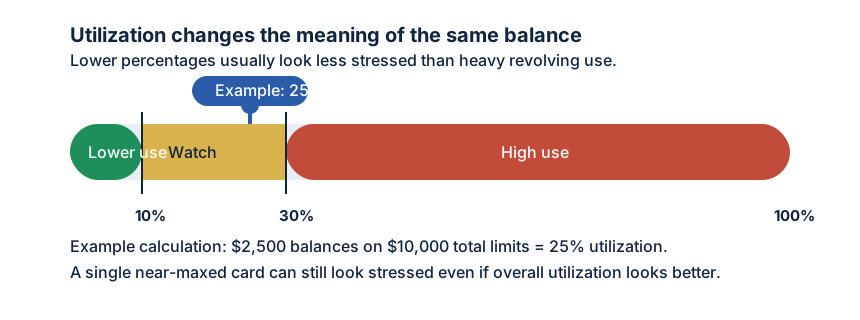
If a borrower has $2,500 in card balances and $10,000 in total limits, the utilization calculation is:
$$ \frac{2500}{10000} \times 100% = 25% $$
Quick Read Table
| Total balances | Total limits | Utilization | Practical read |
|---|---|---|---|
| $500 | $10,000 | 5% | Light revolving use |
| $2,500 | $10,000 | 25% | Moderate use that still looks manageable |
| $6,500 | $10,000 | 65% | Heavy use that can make the file look stressed |
Practical Example
If a borrower has a total of $10,000 in card limits and carries $2,500 in balances, utilization is about 25 percent. If the same borrower carries $8,500 instead, utilization becomes much higher and may look riskier to scoring models and lenders.
The same idea also works at the individual-card level. A borrower may have acceptable overall utilization but still have one nearly maxed-out card, which can still look riskier than a more evenly managed card profile.
Common Misunderstandings and Close Contrasts
Credit utilization is not the same as total debt. A borrower can have modest overall debt but high utilization if the debt sits mostly on a small-limit card.
It is also different from Available Credit. Available credit shows the remaining dollar room. Utilization shows how heavily the borrower is using the limit in percentage terms.
It is also different from Line Utilization. Overall utilization combines all revolving balances and limits, while line utilization isolates one account.
It is also not identical to statement balance timing. A borrower can pay in full every month and still show higher utilization on a report if the reported balance is high relative to the limit when the statement closes.
Related Terms
- Credit Limit
- Available Credit
- Credit Card
- Revolving Credit
- Line Utilization
- Statement Balance
- Current Balance
- Credit Score
- FICO Score
- VantageScore
- Score Factor
- Minimum Payment
Knowledge Check
- What does credit utilization compare? It compares revolving balances to total revolving credit limits.
- Why can utilization change faster than some other credit factors? Because balances can rise or fall quickly as the borrower spends and repays, even when the account itself has been open for a long time.
- Can a borrower pay cards in full each month and still show higher utilization on a report? Yes. If the reported statement balance is high relative to the limit, utilization can still appear elevated when the account reports.