Debt-to-Income Ratio
Debt-to-income ratio compares recurring debt obligations to income to show how stretched a borrower's cash flow may be.
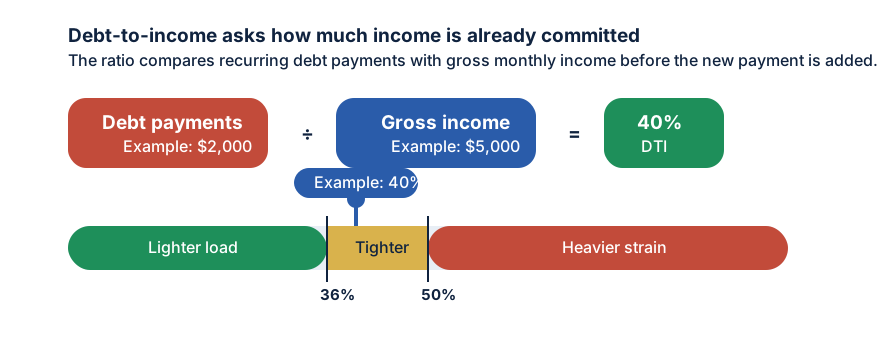
Debt-to-income ratio compares recurring debt obligations to income to show how stretched a borrower’s cash flow may be. In plain language, it asks how much of the borrower’s income is already committed to debt payments before a new account is added.
Why It Matters
Debt-to-income ratio matters because a lender does not just want to know whether a borrower has handled past debt well. It also wants to know whether the borrower has room to take on another payment now. A borrower can have a decent score but still look overloaded if income is already heavily committed.
This ratio matters especially in installment lending because fixed payments can squeeze monthly cash flow. It is one of the clearest examples of why approval is not determined by score alone.
Where It Appears in Real Credit Use
Borrowers encounter debt-to-income ratio during underwriting for loans, line increases, and some other approval decisions. Lenders compare the borrower’s income against Monthly Payment obligations on existing Installment Loan accounts, card minimums, and other recurring obligations. Some lenders frame similar affordability concerns through a Debt Service Ratio.
The term also shows up in debt-management conversations because high debt-to-income can signal that repayment stress is coming even before formal Delinquency begins.
Formula
Debt-to-income ratio is commonly written as:
$$ \text{DTI} = \frac{\text{Monthly Debt Payments}}{\text{Gross Monthly Income}} \times 100% $$
If monthly debt payments total $2,000 and gross monthly income is $5,000, then:
$$ \frac{2000}{5000} \times 100% = 40% $$
Quick Read Table
| Monthly debt payments | Gross monthly income | DTI | Practical read |
|---|---|---|---|
| $1,000 | $5,000 | 20% | Lighter payment load |
| $2,000 | $5,000 | 40% | Material payment pressure, but still depends on lender rules |
| $3,000 | $5,000 | 60% | Heavy payment burden that often raises approval concerns |
Practical Example
A borrower earns $5,000 a month before taxes and already owes $2,000 a month across car, personal-loan, and card obligations. Even if the borrower has a fair Credit Score, the lender may decide that there is not enough room for another large payment.
That is why DTI often becomes a bridge term between credit-file strength and current affordability. A borrower may have decent historical repayment behavior but still look too stretched for the requested new payment.
Common Misunderstandings and Close Contrasts
Debt-to-income ratio is not the same as Credit Score. The score reflects patterns in the credit file. Debt-to-income focuses on the current relationship between required debt payments and income.
It is also not the same as total debt. Two borrowers can owe the same amount, but the one with the lower income may have a much more strained debt-to-income picture.
It is also different from discretionary spending. DTI is usually about recurring debt obligations relative to gross income, not the borrower’s full personal budget.
Related Terms
- Creditworthiness
- Income Verification
- Ability to Repay
- Debt Service Ratio
- Monthly Payment
- Minimum Payment
- Credit Score
- Installment Loan
- Credit Card
- Underwriting
Knowledge Check
- What does debt-to-income ratio compare? It compares recurring debt obligations to income.
- Can a borrower have a reasonable credit score and still fail a debt-to-income review? Yes. A decent score does not erase the problem of monthly payments already taking up too much income.
- Why do lenders care about DTI even when the borrower has paid well in the past? Because past payment behavior does not automatically mean there is enough current income room for another required payment.